Monday, August 12, 2013

Safari!


Arrival

My brother, sister-in-law, and a long time friend were to arrive at the Zambia airport in just a few minutes. I was late because I decided to save money and take a minibus instead of a taxi. I thought I'd stretch my legs and walk a few kilometers from the main road to the airport. Problem was, I got off at the wrong time. I ran into the issue of thinking I was almost there already, but this lasted for what I later found out to be about 16 kilometers. As I watched their plane land, I started flagging down cars, noticing the irritating blisters now forming on my feet where my sandals were rubbing. Turns out a pilot felt bad enough for me to stop. I asked him if he was going to the airport too, and he said yeah, and points to his plane.

The customs line for Chris, Holly, and Adam took well over an hour, so I had no reason to hurry anyway.

Our first night in Lusaka we spent at Lusaka Backpackers, had a few beers, showers, and exchanged stories of the trip. The next day we boarded a night bus headed to Mansa, the capital of my province. This was to be their first real African experience. Crowded bus station, corrupt bus attendants, street vendors (who also come into the bus and bug you about “real zebra leather belts”), delayed departures, traffic jams, and blaring 90's rock music well into the night. But we finally made it to Mansa. Now we sleep.

I arranged a taxi to drive us up north to a series of waterfalls called Ntumbachushi Falls. The driver said he was sick, but he would still be able to drive us the next day. I kindly informed him that we were currently ready to go today. Luckily he came. We hit the grocery store and took off out of town. We were making good time, considering everything, until a loud bang and some uncomfortable vibrations stopped us. Our tire had blown and flown past the window, proceeding to drop the car and catch the front bumper underneath the rim of the once full tire, nearly pulling it off. We stopped to assess the damage. Luckily a spare tire was usable in the trunk, so we got to work fixing that. A group of children came to see what was going on, picking up pieces of the tire on the road along with the chrome strip which normally makes the car look nice. The spare went on, but the bumper wasn't looking so well. Some villagers that head the commotion came to help repair the damage, taking strips of rubber from the broken tire to tie the bumper back into place.

But we made it. Ntumbachushi Falls is a series of 7 or so sets of falls ending with 2 big ones. We built a fire, swam in the icy waters, hiked around, did a bit of stargazing, and tried to relax for a couple days.

The driver was supposed to be fixing the tire the day we were at the falls, so that he could pick us up early in the morning to take us back to Mansa then to my village. A long day of driving. He was 2 hours late.

But we made it. Of course, it was well after dark when we got to my village, and this was after stopping along the road to duct tape the headlight back into place. In the village we greeted most of my neighbors, ate with a few of them, took a long walk across the dambos, watched the newly hatched chicks, played some games, roasted marshmallows, and tried to relax again. All in all it was a great time, that is until our driver was late and wouldn't answer his phone the day we were supposed to leave for Lusaka. I tried calling a number he called me with the day before. It turned out to be his brother who said that the driver was in Mansa and wasn't coming. Uh-oh. Just as I was about to bike into Lubwe and hire a taxi from there, he shows up. Crisis averted.

Apart from almost getting lost in Lusaka, we finally made it to Livingstone to begin the second part of our vacation to see Victoria Falls and go on Safari into Botswana.

Botswana Blitz

Starting from Jollyboys, a hostel in Livingstone, we took off for the Botswana border. After waiting for our ride, (and eating a heaping pile of nachos) we saw the tank of a cruiser we'd be in for the next week. All 12 of us plus a guide and a cook crammed into the tank, bags in the trailer, we took off. The first day was to Chobe National Park, waterfront, along the Namibia border. From there we saw the majority of the wildlife we'd see for the next week, just in the few hours before we set up camp. Included, was a leopard laying right next to the road just a couple yards from us. Each night we'd find a campsite, unload the trailer, set up the tents and tables, then wait for our dinner, which was usually quite delicious.

Day two took us further down the waterfront and out of the park. We reentered at another area of the park to spend the night at Savuti, another campsite within Chobe. After returning from another game drive in the evening, we heard a herd of about 12 elephants just across the river from our campsite. Just after turning off our lights for the night, I heard something walk past the tent. We were at the edge of the camp, so I thought it might be an animal. I poked my head out of the tent, and shined my headlamp around. Just beyond a grouping of bushes, I saw one yellow eye looking back at me. In the morning our guide said yellow typically meany predator, probably a hyena.

Day three we headed out of Chobe and into Moremi Game Reserve. The evening game drive started off quite uneventful, until we noticed some waterbuck off in the distance, stares frozen toward us. Most of the time we'd see impala, kudu, or waterbuck, they'd check us out, and start walking away. This time, we thought something might be different. Stopping just out of some tall grass, about 200 yards away, we saw the first of a group of African wild dog. We started toward it in the cruiser and stopped about half way. In the next few minutes 7 or 8 wild dogs ran within feet of our vehicle. One still had a chunk of meat in it's mouth. Apparently they gorge on meat, then head back to the den to share the puppies.

Day four was to get us to Maun, a city known for it's donkey population. In fact, lots of livestock could be found just walking around the city. Cows in the parking lot, donkeys along the road, etc. We got into a camp with showers. None of us had cleaned ourselves since leaving for Botswana, so we were pretty exited for real showers. We were also able to stop at the grocery store to pick up more water and snacks.

Day five: Okavango Delta. We took off early in the morning to the edge of the Okavango Delta where local mukoro pollers awaited our arrival. Mukoro (or mekoro, for plural) are traditional canoes carved from a single piece of wood. The poller uses a long straight stick to push the mukoro through the grasses along paths cleared by years of mukoro driving. Some mekoro are now made of fiberglass, which seem to leak less. We stopped at an island for a guided walking safari, where a local guide told us about paw prints, trees, droppings, etc. The sun was beating down on us pretty hard, so lunch in the shade was quite welcomed. The night was spent at the fabulous Delta Rain campsite again (the one with showers!)

Day six took us from Maun, leaving behind the donkeys and showers, out into Makgadikgadi Pans National Park, part of the Kalahari Desert. A few kilometers off the main road, we set up camp. As the sun set, the temperature dropped probably 40 degrees. Luckily there was a new moon, so the stars would shine their brightest. This, plus the clear desert air and distance from any cities, gave us a view of the Milky Way I will have to wait a long time to see again. The whole of the Milky Way stretched from horizon to horizon. With binoculars a fuzzy spot became clusters of hundreds of stars. Constellations were hard to find from our star charts because there were so many stars, the bright ones were tough to keep track of. We stayed up late and had trouble getting up in the morning because it was so cold, despite our guide's hyena growl wake up call.

Up next? The legend of the Nyami Nyami at Victoria Falls.

Tuesday, July 9, 2013

Football, Chickens, Food, Hut, etc.

Levy Mwanawasa Stadium, Ndola, Copperbelt, Zambia

A few minutes late

A bit crowded
Mascot

Halftime


No streetlights, crossing guards, manners, etc.

Sunrise in Mabote

Lubwe, overlooking the lake

The Catholic mission that started Lubwe

Lake fly season!

Brick laying. They mold them and let them dry for some time,
then build the tower to burn them solid.

Praying mantis sneaking up my wall.

Mama got stuck in between my roof and plastic covering.

Yup, I can even make pot stickers in the village!

Kitchen

Pantry

Methylated spirits burner.

Methylated spirits burning.

Shelf I made with old bed frame for my clothes,
gadgets, cat, etc.

Living room

The closest thing I have to plumbing.

Shed

At night, on the water, fishermen put out lamps to attract fish. They
leave them out for a while, then scoop the fish up. This is a scene
you can see every night.

Best time of the year to stargaze. There's the Milky Way.

Burning the dambo to make new goat grazing grounds. The black
dots are termite hills.

A typical Zambian meal. Nshima on the left, fish, egg on the right, and
a kale type thing.

My new chickens, Prince and Eve. Eve is currently sitting on 10 eggs.

Mama and Eve don't get along. Eve usually wins any
conflict over food. Here, Mama is spying on Eve taking
a dirt bath.

Although I usually think burning makes everything look bad around
my village, at night it's beautiful.


Thursday, May 30, 2013

Introducing Mama

With the leftover bricks I added a small herb garden, two
flower beds, and a couple spots to try and get trees to grow.

Mama. When I got her she could walk
around on my palm, curl up, and lay down.

Mama, the porker, eating my leftover tuna. She usually looks like
she's just eaten a tennis ball, she's got a gut. I think she eats too fast too,
because she tears up every time she eats something.

Patrick and I eating the 4th goat I've caught.

Women in my fish farming group cooking the goat. I went ahead
and shared with the whole group. The men in the group were
busy fixing the fence around the ponds at the time.

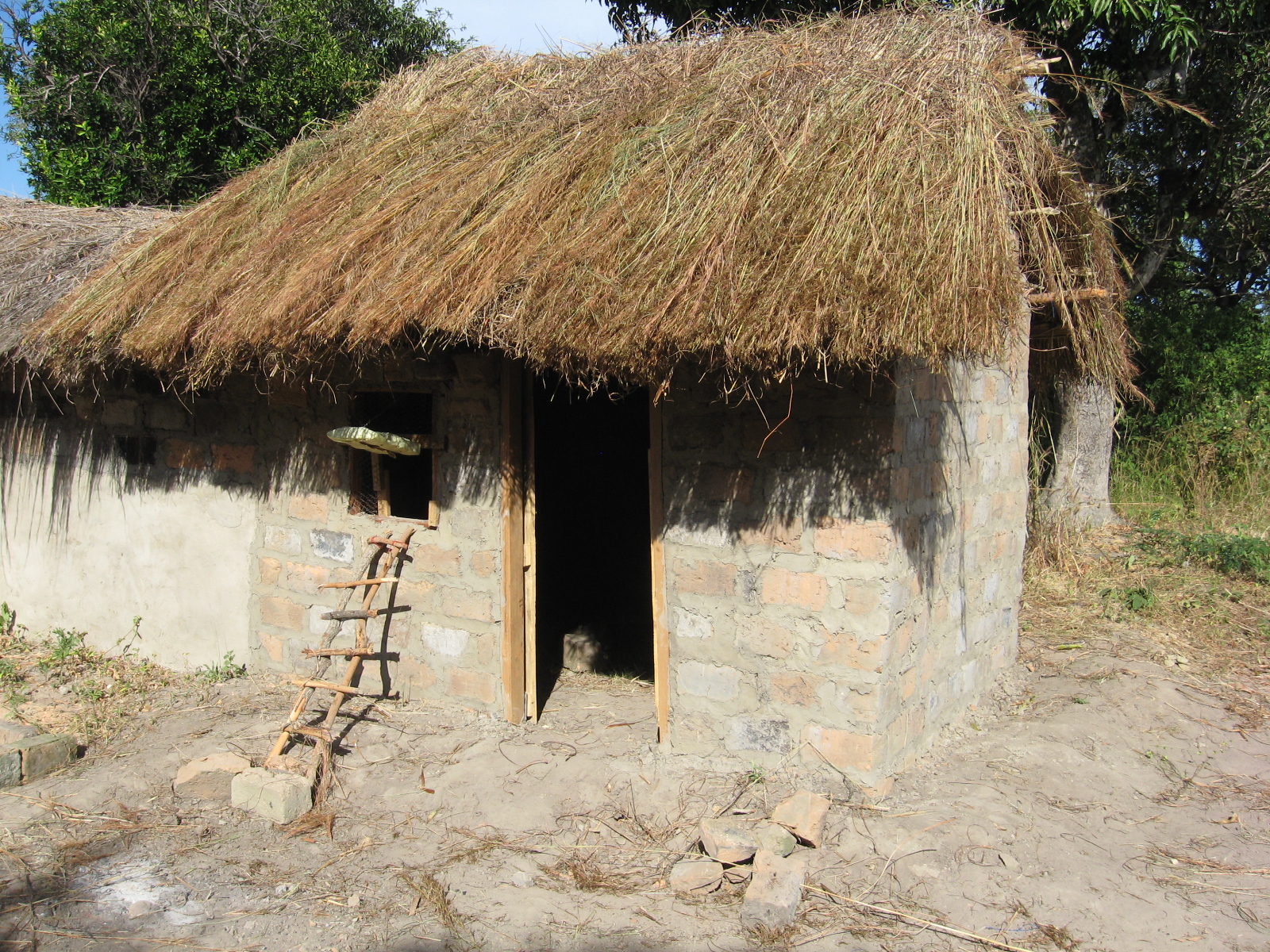
How to Build a Hut

When building a house you first find some clay, which is everywhere. Get a few pieces of wood and mold your bricks (pics soon). Lay them in the sun for a few weeks, then you'll want to fire them. Since you don't have any electricity and a kiln anywhere nearby, build a "chimney" out of the bricks. Basically they stack them up kinda like a pyramid with little compartments in the bottom where they put some firewood. Then cover the whole thing in fresh mud to seal it off. Fire it overnight, let it cool, and you've got yourself some fresh new bricks (pics to come soon). Usually people just make the bricks where they are going to build the structure, so you don't need to move the bricks.
 Cement can be bought in town, but most people just use clay again to mold between the bricks. Houses don't last forever around here, with the rainy season, termites, kids, etc. The first bricks are dug about half way into the ground, string and stakes make for straight lines, and you just eyeball to make it level.
 Windows are typically just holes in the laying of the bricks, sometimes people get fancy and put the bricks in diagonally. I wanted wooden framed windows that I could put chicken wire on, as well as have a little chicken door/flap/thing. Some houses don't have doors either. I went ahead and got a door made with a frame and all that. I got a sliding lock and instead of drilling a hole we lit a fire and heated up an metal rod, then sizzled away the hole.
 On the inside there is a big log dug into the ground that holds the top log in place. Angled sticks are nailed into the top log and just lay along the edge of the structure.
Patrick and Mayben tying reeds in a grid along the sticks. Villagers typically use a type of bark soaked in water that works like a rope, then dries hard. Peter untwisted some rope I had to tie for this job. Yes I paid them, gave them some money to go get fish at the market, then my cat stole some.
 There are several types of grass that grow around here. (I actually measured one at 15 feet tall, and that's not getting into bamboo) This grass isn't ideal, I think the good stuff grows later before the rains start, but this'll do. I don't think the chickens will mind. The grass is sometimes tied, sometimes just layered and held in place by it's own weight.
And you're pretty much done. I'll go back and put some plastic underneath the grass on the inside to keep the dust down and some leaks under control. Most villagers don't have plastic inside their huts. So, all the materials can be found nearby, in fact you can build the whole thing for free if you don't include a door or labor. Most villagers can do all of this, although some specialize in brick laying, thatching, carpentry, etc. to make extra cash.

Tuesday, May 21, 2013

Updates All Around!


So what's new in the last month or so?

Well first of all when I got back from Lake Tanganyika, Bagheera decided to go off on some wild adventures. My counterpart, who was taking care of feeding Bagheera while I was gone said that he had eaten his food the night before I returned, but no one had seen him since. While I hosted 2nd site visit I heard nothing about him until I brought it up at my fish farmers meeting. One of my neighbors said he had seen Bagheera near his house for the past few nights. So for the next few evenings I went to his house to call for Bagheera (he knows his name). But I didn't have any success. Then I hear that guy's neighbor started hearing him in the night. So I went over to his house after dark to look for him. Still nothing. So I opened it up to anyone in the village who could either come get me when they found him, or bring him to me, I'd pay them. Still nothing, though people still talked about seeing and hearing him. I don't get it.

Just before this was going on, I was looking for puppies. I have wanted to get a dog but since I travel so much I wanted to make sure I had a neighbor who would “own” the dog, and I'd help pay to feed it. I did have a neighbor lined up, now I needed to find the right puppy. I was going to get a puppy from one of my nearest volunteer neighbors, but she got relocated due to some safety concerns at her site (nothing too serious). So getting those puppies fell through. But I did find a puppy being sold in the next village over, so I decided to go take a look. The one who hadn't been sold yet cost 5 kwacha, about a dollar, but was still too young, so I'd have to keep checking back and wait.

While this was going on I went to visit another neighbor, Diana, and while at her site, while she was doing laundry on her porch, right in front of the door, a tiny kitten walks straight into her house. So now I'm catless, unsure about a puppy, and my friend now has 2 cats, and the big one has a problem with the small one. One thing led to another and we named it Mama, after her cat, Papa. And I took it home on my bike in a basket, 26 miles of bush paths and bumpy dirt roads.

Mama is completely different from Bagheera, but it's more her attitude. For instance, she likes to climb trees like Bagheera did when he was young. Mama though, climbs them, cries for hours because she can't turn around, gets tired, and passes out on the branch. Sometimes I have to go save her. She also didn't come home one night because she climbed up on the not finished structure of my chicken house and couldn't get down.

Oh yeah, I finally finished my chicken house. I know some of you were wondering how people build houses here. I've documented the whole process other than making the bricks (which I should have soon soon). Making my chicken house is similar to how they build their houses, so you'll get the idea.

With the leftover bricks from the chicken house, I made a few additions to my land. I'm fed up with dealing with goats eating all of my vegetables, I tore down my first nursery garden, and the living fence for my big garden isn't living so well. So, The main thing I built is a raised circular herb garden. It's a lot smaller, but since it's smaller and closer to my porch, I can care for it easier. Hopefully I can eat some peppers soon. I made a few smaller flower and herb beds, as well as put some bricks around some trees I'm desperately trying to make live.

In other news, due to some scheduling conflicts, I was given the choice of where I wanted to do PEPFAR training. PEPFAR, I forget what it stands for, is an initiative to help spread awareness and education about HIV/AIDS. So, in June I'll be heading to Northwest province for a week long training with a counterpart so that we can take the information back to the village and host workshops, etc. Turns out on the day we leave PEPFAR training, Chipolopolo is playing in Ndola. So I'll be able to fulfill my dream of being a soccer hooligan for an evening. Chipolopolo (meaning “Copper bullets” because of the Copperbelt (which made Zambia, Zambia))) won the African Cup a few years ago. Saying you aren't a Chipolopolo fan in Zambia is about as insulting as saying you don't take (eat) nshima (their main dish).

I was supposed to get a fingerling delivery a few months ago, but the night before they were supposed to deliver the fingerling production plant found out they didn't have plastic bags for delivery or oxygen to put in the bags to help the fish survive longer. So, last week I went and bothered anyone I could about when I'd get the fingerlings. I talked with just about every person who could get the job done, and as far as everyone says, I'll be getting fish in my ponds later this week. I also bothered the Department of Livestock and should be getting a Newcastle's vaccination in July to vaccinate as many chickens in the villages as I can. Newcastle's is probably the #1 killer of chickens in these parts. Plus, by that time I'll have my own chickens so I'll get them vaccinated as well.

(Side note: I'm posting this blog a day after I wrote it, and I was just informed that the fingerlings won't be coming this week, but maybe next week. Again.)

I also got my first case of Malaria. Luckily I was at the provincial house at the time, so I had friends and things readily available to help me out. It began with horrible headaches one morning, which I helped treat with some Tylenol, but by the evening I was in bed rolling over with cold sweats, which continued throughout the night. The next morning I called medical to explain my symptoms and they started me on Coartem, the malaria treatment medication. You take 4 pills twice a day for 3 days. I've taken 5 of the doses and I'm feeling much better. The second day I had to keep a steady input of Tylenol to keep the headaches and cold sweats down. Today I feel I can probably make it without any other meds. The good news, I'm instructed by medical staff to eat a high calorie diet, because Coatrem does a number on your liver. So this morning, with my appetite back, I had 2 buttered pieces of toast, 3 scrambled eggs, and a bowl of ice cream!

(Again, since I'm posting this a day later, I'm feeling very well and haven't had Tylenol for some time.)

I also caught another goat. Ate it this time.

Sorry no pictures this time, internet has been awful around here.

Thursday, April 18, 2013

Stomping Out Malaria in Africa

Blog About Malaria Month

Malaria is the #1 killer in Africa.

April is malaria month, and I, along with over 3,000 other volunteers in 25 African countries are helping raise awareness around the world about malaria. Each Peace Corps country in Africa is in a competition against each other, scoring points for holding workshops, playing games, teaching songs, posting pictures and blogs, etc. So far I've heard Zambia is in the lead, so I'll do my part to keep us on the winning track.

I've mentioned in another post, I'm working as a research assistant in a net study looking at how nets are used in the village that will help to build better strategies in net distributions and prevention methods. Many of those nets do help decrease the spread of malaria, but malaria still plagues this part of the world. Luapula Province has the highest rates in Zambia. Although nets are given out, and even have descriptions of how to use, clean, and hang them (even in several different languages), many go unused, or used for other purposes (like fishing). Not only that, there are many misconceptions about malaria and it's deadliness in rural places like where I live.

During my first site visit when I spent a few days with an agriculture volunteer in Central province, I was talking with another volunteer who came to stay with us and help us cook and keep us company. We were talking about how some people will take any signs of sickness and associate them with malaria. I thought that although this is a bad way to go about it, it was nice to know that they weren't just blaming everything on juju (think witchcraft). Though it is nice to think that way, the most likely thing that happens is someone “put the juju” (think cursed) on another person to get malaria. So we're no further than we were before.

A few weeks ago I was talking through the next village with one of my counterparts when 3 villagers were escorting a frantic woman. She was being led by the arms by her family, a look of terror in her eyes, she couldn't focus on anything, her eyes darting around, and her whole body shaking. I asked Martin, my health counterpart, where they were taking her and what would happen. He said they were taking her to a traditional doctor. I asked what would he could do. Luckily, Martin is well educated, his response, “Probably nothing”. He asked me what I thought about it. I said that I wasn't a doctor and am not qualified to really help anyone, but that it appeared she could either be dehydrated, where all she needs is some water and rest, she'd be fine in a few hours. Or, we could be looking at another extreme, where she could have malaria, she's suffering from shakes that are associated with this type of malaria, and without treatment with medication specifically for malaria, she could be in serious trouble.

Many times I hear people finally make it to a clinic, sometimes dozens of miles away, where they can get proper treatment, and though they may get a test and test positive for malaria, the clinic is out of medicine like Coartem, and just prescribes Tylenol. But most of the time people will not seek the  treatment they need. Other times villagers may just assume any sick feelings must be malaria, so they buy Coartem to treat something that may just be a cold.

Around the villages tons of myths originate around malaria, and working against these myths to promote the truth is difficult to say the least. Most villagers believe:

·                     Getting wet in the rain will give you malaria
·                     Eating sugarcane can give you malaria
·                     Eating raw mangoes can give you malaria
·                     All mosquitoes can transmit malaria
·                     Drinking water from certain wells gives you malaria
·                     Any headache, body ache, cold or flu must be malaria
·                     Rest alone will cure malaria
·                     Using mosquito nets to catch fish is more worthwhile than sleeping under them
·                     If a pregnant woman has malaria, she’ll know it because her symptoms will be much worse
·                     Mosquitoes live in grass
·                     You can get malaria at any time of the day, therefore its senseless to sleep under a net only at night


The truth? Malaria in this area is of the world is caused by a bite from a female Anopheles mosquitoes, only when they are hunting from the hours of about 11pm – 4am, and only if they are infected with Plasmodium falciparum. In the daytime they rest on the inside walls of buildings. The best and cheapest prevention method is the widespread use of mosquito nets, especially from vulnerable groups like children under 5, pregnant women, and those suffering from HIV/AIDS. The best primary medical treatment is Coartem.

There are some other challenges that face Zambians besides misunderstandings. Making it to a clinic is time consuming and expensive. Hiring a taxi is out of the question, I've never taken a taxi to my hut because it's too expensive. I know my neighbors can't afford it. Then the only other options are walking all day with a sick person, or paying someone to bike, riding on the bike rack. And like I said, sometimes the clinics themselves are out of medicine. The World Health Organization recommends you begin treatment within 24 hours of symptoms. If I wasn't already supplied with a malaria test kit and Coartem provided by Peace Corps, I'd even have difficulties getting treatment within 24 hours. In more developed areas they spray the insides of walls (a method that has been incredibly effective where they keep it up), but I don't think they've ever made it near my village.

But there is hope. The misconceptions are getting more sparse, education about the real cause of malaria and it's treatment and prevention is everywhere. Being as how widespread and damaging malaria is in a place like Zambia is, the Zambian government, NGO's, and aid agencies around the world are pumping money and resources into decreasing the devastation malaria has brought, which may some day allow poorer countries like Zambia to benefit from one less debilitating disease and focus on development uninhibited.

What am I doing? I'll be working soon with Martin on a workshop for my surrounding villages. We want to focus on building tippy taps (handwashing station with a bucket of water and pedal to “tip” the water into your hands) to help with hygiene, SoDis (solar disinfection) to clean water without chopping down more trees to burn and boil water, and simple things people can do to decrease chances of getting malaria. What I'm hoping to do is find a few community members that I can teach with Martin to be “community experts”, if you will. They will be the ones holding the workshop, I'll be in the sidelines. My opinion is people coming in and teaching workshops, though helpful, are not as sustainable as they could be. I'm trying to work myself out of a job. If they have the power to hold their own hygiene workshop without me, I've done my job. For the malaria prevention I'm hoping to get higher up village members to show everyone their own mosquito nets, so all community members see that even the headmen or headwomen sleep under nets just like they should. Something I've seen is that many people don't try to fix holes in their nets, so I'll focus on 3 ways to fix holes, stitching, patching, and the easiest, a knot. I'll let you know how things go.

How will you Stomp Out Malaria in 2013?